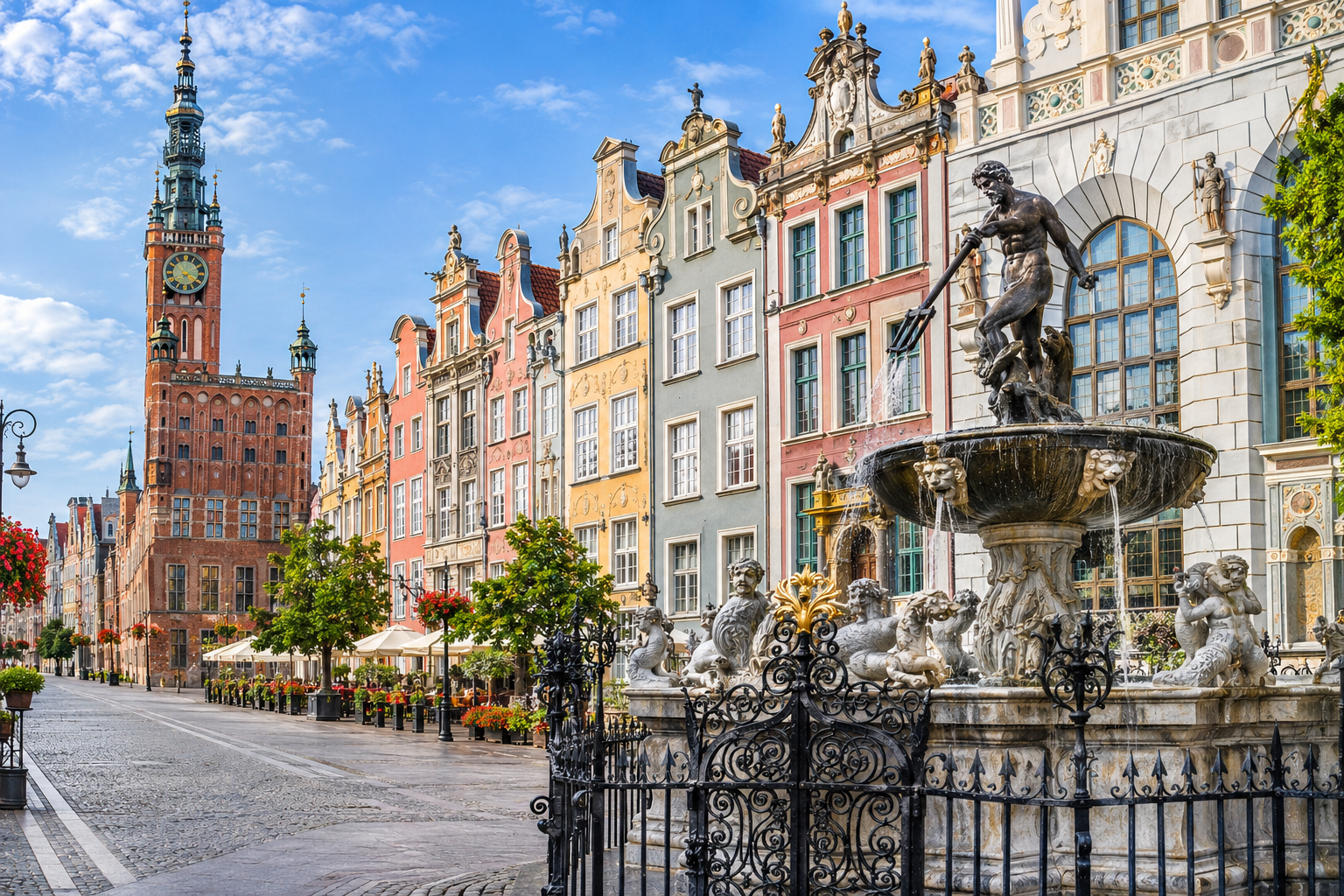
Read the Main Town as a port landscape
Gdańsk’s Long Market and the streets around it are often the first encounter with the city. Tall merchant houses, the Neptune Fountain and the brick mass of St. Mary’s Church communicate a history tied to Baltic trade and civic wealth. This is the Main Town, not the whole city and not a frozen medieval tableau. As you walk toward the Motława, look for the relationship between the grand façades and the working waterfront that once made the port’s prosperity possible.
Move from the gate to the water
A useful walking line begins at the Golden Gate, follows the Long Market, then turns toward the Green Gate and the river. At the waterfront, the medieval crane stands as a reminder that Gdańsk’s skyline was shaped by labor and commerce as much as by churches and patrician houses. The Maritime Museum sites around the river help explain how ships, warehouses and the city’s position on the Baltic formed an urban system. Leave time to linger along the quay rather than completing the route at speed.
Make room for the twentieth century
Gdańsk is central to several histories that reach far beyond its photogenic centre. The Museum of the Second World War approaches the conflict through a wide international frame; the European Solidarity Centre addresses the workers’ movement and political transformations associated with the shipyards. Each asks for attention and time. Consider choosing one for a given day, then walking near the former shipyard district to connect the museum’s story to the city’s changing industrial landscape.
Extend the city toward the coast
The urban area connects to the broader Tri-City region, including Sopot and Gdynia. This makes it possible to build a stay that alternates between historic streets, modern port architecture and the Baltic shore. Sopot’s promenade and Gdynia’s twentieth-century character differ sharply from Gdańsk’s merchant core. Treat the regional connection as an opportunity to compare places rather than as a race to collect three city names. Rail and local transit serve the corridor, but plan from current schedules for the date of travel.
A slower itinerary holds together
A compact first day can follow the Main Town to the waterfront. A second day can focus on either the war museum or the Solidarity Centre, with the shipyard district as a walk. Reserve another half-day for the coast if the sea is part of your reason for coming. Gdańsk’s weather and waterfront light can shift quickly; a flexible order lets you move indoor visits around without losing the structure of the trip. The strongest impression comes from seeing both the elegant port city and the modern history built alongside it.