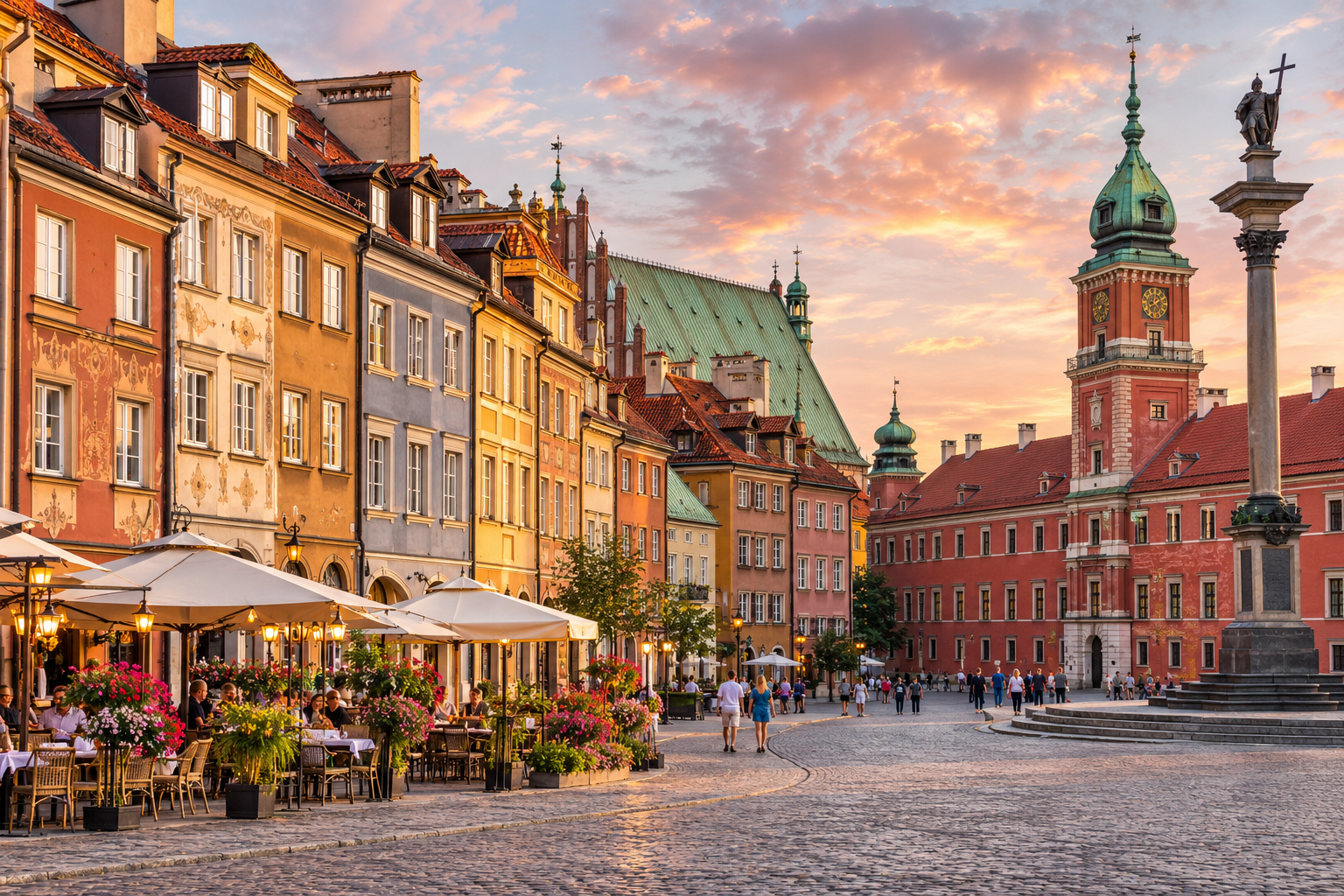
Start with what the Old Town means
Warsaw’s Old Town looks historic, but much of it was reconstructed after the destruction of the Second World War. That fact does not make the place less meaningful; it changes the question you bring to it. The Market Square, narrow lanes and Royal Castle area are a monumental act of rebuilding, recognized for the way a damaged city was restored. Notice how the façades create continuity while the city around them carries a far more complex twentieth-century story.
Walk the royal axis in sections
From Castle Square, Krakowskie Przedmieście leads south along a ceremonial route of churches, palaces, university buildings and public institutions. It eventually meets Nowy Świat and continues toward Łazienki Park. The entire axis is long enough to deserve breaks. Take it in sections: the Old Town and university area in one walk, then the southern stretch on another day. The route gives a strong sense of Warsaw’s scale and its habit of placing layers of power, culture and everyday commerce on the same street.
Give the river its own perspective
The Vistula is not a decorative edge but a major part of the city’s geography. From the central districts, bridges connect west-bank streets to Praga on the east side. The riverfront paths and green banks offer a more open counterpoint to the formal centre. Cross by a bridge when the weather and your energy allow, and spend time on the east bank to see the skyline from a different angle. The contrast between reconstructed historic areas, modern development and surviving neighborhoods is more revealing than any single viewpoint.
Read the city through its museums and memorials
Warsaw’s museums are not interchangeable rainy-day options. The POLIN Museum of the History of Polish Jews provides a broad account of Jewish life in Poland, while the Warsaw Rising Museum focuses on the 1944 uprising and its consequences. The National Museum offers a different route through art and national collections. Choose based on the question you want to carry into the rest of the city. Allow substantial time and avoid stacking emotionally demanding sites back-to-back.
Pace the visit around neighborhoods
A balanced two-day visit might pair the Old Town and royal axis with a second day for a museum, river walk and a neighborhood beyond the ceremonial core. Warsaw’s metro, trams and buses make longer jumps practical, though service patterns and fares can change; use current local information when planning a specific connection. The city is a rewarding place to revisit because each trip can take a different lens: reconstruction, Jewish history, architecture, contemporary food culture or the relationship between the capital and the river.